Friday, November 25, 2011

"This is haw you make cocoa"


Although I live in a TV-free household, my son has watched his fair share of cartoons and the like. We have been selective, but now that he's older, I'd rather show him more educational videos rather than just funnies.

Jonah recently got an advent calendar in the mail from his Czech grandma. Perfect, I thought. The back of the box described the company's commitment to fair trade and showed photos of several farmers in the cooperative and of the cocoa bean picking and roasting process. I thought, why not learn a little more and got busy on youtube.

Surely enough, I found three short, accessible segments about the history and making of chocolate. We watched and discussed. Jonah was engrossed.

First we watched a video on unfair and abusive labor practices on cocoa plantations in Ivory Coast:


Next we watched a video discussing the reasons why it is important to support fair trade chocolate:


And, finally, we watched a clip made for kids about the history of chocolate and how it is traditionally picked and made from cacao beans:


Apparently my little first-grader was still processing all the information later when we were playing scramble-unscramble words with Scrabble tiles. He wrote: "This is haw you make cocoa."

I remember when he was about three, while we lived in Prague I showed him one of his first "educational" videos. It showed how hot dogs are made. My hidden agenda was that he would be so disgusted that he'd stop begging me for a hot dog from the stand on the way home from school every day. To my chagrin, the video of machines mixing powders, stuffing casings and pooping out hot dogs made him even more excited about this dubious food item. Kids are funny, funny people.

Friday, August 12, 2011

The Big Six


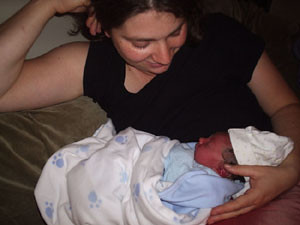
My son was born 6 years ago yesterday! Oh my! Was it just yesterday or a hundred years ago? Motherhood. What a trip. I remember both this (2 weeks before Jonah was born):


and this (his first night home)... so vividly, yet like it was a dream:

happy mamma copy


To celebrate the occasion, we went camping by a river. It turned out to be a favorite summer experience for all involved:


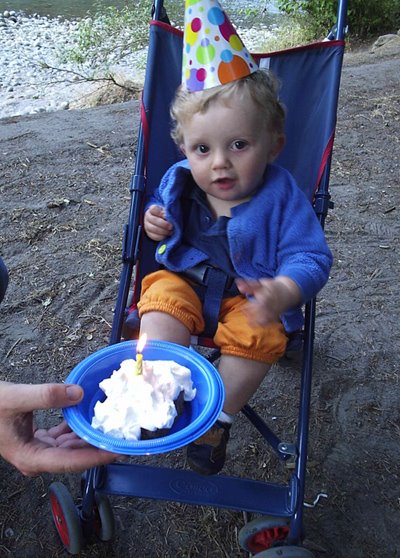
And this is Jonah at one on the shore of the same river where he celebrated his sixth birthday (notice the hat - haha):


Monday, January 31, 2011

flowers for Amalia


Tomorrow marks the third anniversary of Amalia's birth. As time goes on, the pain of her death, only eight days after she was born, lessens. But the memories don't fade. And, to be honest, the aversion I have to many of those memories lingers.

Why aversion? And what a horrible thing to admit! I am only telling the truth. Amalia's short time with us was spent in intensive care. When not by her bedside in the hospital, I was home with my son, my mind flooded with worry and fear. At night, I could barely sleep and the nightmares that overwhelmed me were epic.

I am still in the process of teasing out the good from the horrific. The moments of tenderness are what must be raised above the rest:


Amalia's tiny, soft hand against mine; her warm head nestled against my chest when I held her (albeit only once); my lips against her hair and forehead; the songs my sister and I sang to Amalia incessantly while she was alive; the flowers and wishes family and friends had sent; the care of the nurses and doctors--institutional, but golden; my milk that flowed via tubes through her veins; the hospital window with a view, high up on a hill, gray clouds rushing by, pine trees swaying in the hostile February air; the rain drops pounding the windshield as I pushed ahead, driving to see her each day; ginger tea in the dark because I could hardly eat; bitter herbs because I could hardly sleep; her little face so much like her brother's; her reddish brown curls, dimpled knuckles, round belly, purple heels; the relief when she was breathing; and, finally, the sorrowful parting: ashes set free in a fast-flowing river full of heart-shaped stones.

Thank you for these flowers today, Jenni and Andy, Amalia's aunt and uncle, two of the very few people who got to meet her.

Friday, October 08, 2010

good cop, bad cop?

"Mom, do all police do a bad job? Or do some police do a good job?" my son asked me this morning. "Why do some police do a bad job?"

It has been two weeks since I have taken my son with me to a police accountability rally in our hometown, and Jonah is still thinking about it. Inspired by his questions, we talked a bit about the possible reasons for why some officers may not follow protocol, and why some end up using excessive force.

At the protest, we listened to speeches given by community activists who have struggled to reform our city's police department. We heard from parents and young people affected by police brutality. The fathers of two young African-American men recently murdered by white cops were there too, although they did not speak. It was emphasized that communities of color and the homeless are disproportionately targeted by the police in our town.

Jonah asked to hold a sign and, for the first time while attending a rally with me, expressed interest in discussing the issues at hand.

My grandmother is of the opinion that five-year-olds are too young to attend protests. I disagree. I would rather expose my son to real issues and people taking action to change policy and practice for the better. Especially as someone growing up in this country in relative economic comfort and with white privilege, authentic experiences like these are crucial in his formation of a sense of community, ethics, justice and responsibility.

My son could be at home watching a Disney cartoon or playing with Legos on a Saturday morning (although we are actually a TV-free household), or he could be witnessing grassroots activism in his own community. I prefer the latter, when the opportunity for us to engage together is there.

Of course, that afternoon after returning home, Jonah whipped out his guns and played soldier in the backyard. Boys will be boys. But now he's at least learning about how serious and irreversible the damage guns cause is in real life.

Monday, June 07, 2010

Discipline the unconditional way... say what?

To be honest, I've never been very fond of the modern, widely endorsed parenting techniques of "time-out" and, on the flip side, of rewarding positive behavior with praise or symbolic treats (such as stickers...). The traditional authoritarian style of parenting has never agreed with me either. My sister and I, for one, weren't spanked or threatened into behaving well as children. But why exactly do these styles not feel right to me? I've contemplated it; it's because they strike me as coercive and controlling.

Of course, the parent must be an example and a guide, straddling the line between compassionate and firm, but is it not possible to raise our children with deep respect and empathy without manipulation?

One of my heroes in the field of education, Alfie Kohn, has written an excellent piece on unconditional parenting. What a concept.

In Parental Love with Strings Attached, which appeared in the New York Times last fall, he explains:

Conditional parenting isn’t limited to old-school authoritarians. Some people who wouldn’t dream of spanking choose instead to discipline their young children by forcibly isolating them, a tactic we prefer to call “time out.” Conversely, “positive reinforcement” teaches children that they’re loved – and lovable – only when they do whatever we decide is a “good job.”

This raises the intriguing possibility that the problem with praise isn’t that it is done the wrong way -- or handed out too easily, as social conservatives insist. Rather, it might be just another method of control, analogous to punishment. The primary message of all types of conditional parenting is that children must earn a parent’s love.


As a parent of a talkative, energetic and willful boy, I am having to forge my own way that agrees with my philosophy on life and one that obviously complements my husband's.

I'll admit that disciplining my son has been quite the trial and error approach, often inconsistent, experimental in nature, and perhaps a bit loosey-goosey to outside observers. Sometimes I'm gentle and communicate clearly, other times I slip into patterns I'm not so pleased with. But I am definitely very hip to this idea of unconditional love, and so rather than imposing an iron fist, I prefer talking through problems with my son and being emotionally open and accessible. I want my son to gain a deep understanding of how his behavior affects other people. I want him to develop his own internal behavior compass based on empathy and real-world relationships.

Alfie Kohn cites scientific research showing that: "Children who received conditional approval were indeed somewhat more likely to act as the parent wanted. But... they tended to resent and dislike their parents... They were (also) apt to say that the way they acted was often due more to a 'strong internal pressure' than to 'a real sense of choice.' Moreover, their happiness after succeeding at something was usually short-lived and they often felt guilty or ashamed."

Additionally, grown-ups, who as children "sensed that they were loved only when they lived up to their parents’ expectations, ...felt less worthy as adults."

In short, as Kohn asserts, using love withdrawal as a parenting method "isn’t particularly effective at getting compliance, much less at promoting moral development."

So, what is Kohn's answer and how does it mesh with my own ideas of parenting with unconditional love?

Kohn's conclusion, based on scientific research from the field of psychology, is this:

"Unconditional acceptance by parents as well as teachers should be accompanied by 'autonomy support': explaining reasons for requests, maximizing opportunities for the child to participate in making decisions, being encouraging without manipulating, and actively imagining how things look from the child’s point of view."


The idea of "autonomy support" is quite in line with how I was raised and with how I am trying to parent Jonah. In reality, to love someone unconditionally is one of the most difficult human tasks. I sometimes forget and raise my voice, I'll be honest. But I'm giving it my best shot, always questioning my own motivations and recommitting myself daily to basing my interactions with my son on mutual respect, empathy, and joy. In my professional life as a teacher, as well, I have made it a goal to try for the same kind of approach with my students. Parenting and teaching with unconditional love. What a trip.

Saturday, March 27, 2010

away we went


My first time stealing away from Jonah was when he was three months old (around the time I went back to work). I spent the three sinful days (mom's guilt; I know other mothers can relate) with my sister and mom in Seattle, pumping breast milk like a dairy cow while--the devoted groupie that I am--admiring my sister in concert and revisiting with two of the women closest to my heart the places we lived and frequented once upon a time when Seattle was our first American hometown.

Now Tim and I have both had opportunities to take breaks from the incessant duties of parenthood for the occasional night or two (or a few), but as a couple, we haven't had many chances to get away together. In fact, last month was the first time we left town without the little guy for just one night. (Little guy is four-and-a-half by now already, mind you!) And just last week Tim and I spent several days alone together on a trip to New Mexico, thanks to Jonah's paternal grandparents, uncle and aunt, who took care of him in our absence. And what an amazing experience that trip was!

I have traveled around the US quite a bit, crossing the continent from one coast to the other seven times by land, and traveling North to South the slow way many times. I've spent time in (not just driven through) nearly half the states, but this was my first time in New Mexico. I am still digesting the impressions I took away from that place.

Aside from the magnificent and varied scenery and scrumptious food of New Mexico, which both floored me, I was most affected--disturbed and simultaneously moved--by the state's history. For me, visiting New Mexico was, for the first time entering flourishing Native America, and I tried my best to be a humble guest. New Mexico, unlike any other part of the US I have come to know, is a place where the dominant paradigm is not Anglo, but indigenous. The truth is that--and I don't care if this sounds crazy to some of you--many aspects of the Anglo world just don't sit well with me. So being in New Mexico--with its painful, yet inspiring history of Native American triumph despite the violence inflicted on the Pueblo Indians by the Euros and Anglo-Americans, I felt a sense of relief and reverence for the incredible strength that it took for the people of New Mexico to assert their ways and persevere.

I was so moved by this that while taking in local history in museums, books and in remote places as well as cities, I was often unable to hold back my tears. I am always very careful not to romanticize events or groups of people, but I do have to acknowledge my admiration here. The whole trip, I felt so deeply for the people and the land. I was especially moved when reading about the Pueblo Indian revolt of 1680 against the Spaniards, which, in the words of author and historian Joe S. Sando, a Pueblo Indian, "made it possible for the Pueblo people of today to remain on their traditional lands, thus preserving their farmlands, their culture, and their way of life."

During the trip, I took note of how differently history is told depending on who tells it and who funds the effort. Yes, it's true; my heart tends to root for the underdog. But I am not naive. I also understand that the assault on the local people's way of life is far from over. It continues, one of the ways being the dumping of nuclear waste on the native people's land. So, the fight is still on.

I am so grateful Tim and I had this opportunity to travel and learn in the process. Lucky us, indeed. Jonah did great without us from what we heard. And I hope that some day we will have the chance to return to New Mexico. It really is a special place.

Tuesday, March 16, 2010

Diversity at my son's school: are they for real?


A couple of years back, when I was still a columnist for Anti-Racist Parent--now renamed Love Isn't Enough--I wrote a piece in which I surveyed my son's library to examine gender stereotypes and the representation of people of color in his books. I took a trip down memory lane this week, and conducted a similar experiment at his school during my short stint as a volunteer at a Scholastic Book Fair/Fundraiser. Fascinating.

Of course, the school AND the company Scholastic both like to pay a lot of lip service to "diversity." Who doesn't these days.

The first article by Scholastic on "diversity" that popped up in my search says:

Even 3 and 4 year olds are tuned in to matters of culture and ethnicity. For them, the issues are not social but personal, and are closely related to their self-esteem. . . If your child's preschool validates cultural diversity, you'll know it just by looking around. Are a variety of faces represented on the walls?


That article was published in 1996. So, how is Scholastic doing now as far as honoring diversity with the reading materials it sells in the communities who choose Scholastic book fairs as venues for fundraising?

First, let's look at my son's school community. I know that each classroom, during enrollment, tries to balance equally the gender represented in the student body. Racially, in my completely unscientific estimation, the population of the school is about eighty percent white, reflecting--and possibly proportion-wise surpassing--the racial make-up of Portland, the whitest US city with a population of over half-million. (Portland is about 78% white, while the state of Oregon is 87% white. Just to throw in a bit of trivia, the Czech Republic, where I grew up, is about 97% white). Religious affiliations are impossible to determine, though I know for sure that at least three major religions (Christianity, Judaism, and Buddhism) are represented. A myriad of ethnicities are represented, however, the only ones I can determine, other than those overrepresented in the region (e.g. Anglo-American and Scandinavian-American), are ones based on the languages I've heard at the school. I have heard Vietnamese, Chinese, French and Spanish. The languages spoken, of course, don't necessarily give me information on specific ethnicities (for instance, a French speaker could be Canadian, Hatian, or French among many other possibilities) but at least we can establish that a percentage of children at my son's school are growing up bi- or multi-lingual.

Let me just say, that to some, this may seem like an odd exercise in face value symbology. But we would be kidding ourselves if we asserted that we live in a colorblind society and that our ideas about people are not influenced by the racial, gender, and many other types of stereotypes which we encounter just about everywhere--in the media, in books, in advertising and entertainment, in our families, etc.

So, I was curious to see what a giant such as Scholastic was doing to educate our children, and if their book selection for the young was reinforcing or helping to shatter two categories of stereotypes in particular: gender pigeonholes and stereotypes about people of color still so prevalent in this society.

As far as gender, I counted how many book covers featured girls and women, paying attention to the numbers of "visible minorities" (yes, indeed a subjective definition), and to what the girls were pictured doing. Were they shown in midst of interesting and varied activities or just standing there looking pretty (and pretty "useless")?

As far as race, I took note of the number of books showing people of color, and again in what context they appeared.

In this survey, I only focused on book covers due to a time constraint, and because it is the cover that usually determines whether parents and children choose the book to pick up, flip through, and possibly purchase.

So, what was the Scholastic preschool/early elementary-level book selection like? Here are my findings:

Of the nearly 300 books displayed, 75 portrayed people only, and 21 showed people and animals together. The rest of the book covers showed either only animals, a scene, a building, or nondescript characters such as aliens. So, about one-third of the books for sale featured people on the front covers.

Of the approximately 100 covers with people on them, 20 featured "visible minorities." Of those books, 11 displayed girls or women on the front, interestingly almost always with one or more males. Four books showed people of color interacting with animals, six showed people of color alone (though I'm being generous here, because one cover was of a must-look-very-closely-to-ascertain African-American boy's arm carrying a suitcase--and I still counted it). Finally, ten, or about half, showed "visible minorities" together with whites.

Three of the twenty books with people of color had Asian-Americans/Pacific Islanders on the cover. Yes, that's three out of 100 when my son's school has quite a few students of Asian heritage, and when the Portland population is more than twice that, percentage-wise. Needless to say, I was disappointed to see such underrepresentation.

Only one of the books had a Latina on the cover (Dora, the Explorer). That's right; only one out of a hundred books showed a Latina, while Latinos, according to the US Census Bureau, represent fifteen percent of the US population, and in the greater Portland Metro area, depending on the location, 7 to 50% of the total local population.

Sixteen of the twenty book covers featuring people of color showed African-Americans.

Eight of the books with "visible minorities" on the front focused on athletes, all African-Americans, and all but one of the many athletes shown on the book cover "collages" were male sports figures. Additionally, two book covers showed Barack Obama--one where he was alone and smiling, and the other where he was smiling, surrounded by his smiling family. Are you smiling yet?

So, let's talk more about what we see people of color doing on the book covers. The Asian girls are just standing there, one looking startled (whoa, she's not smiling!), the other... drum roll... smiling pretty. The one pair of Asian parents we are shown is smiling, climbing up and hugging a giant dinosaur. And Dora? She's at the doctor's office, sitting on the examination table with a stethoscope in her ears. Dora--pictured with a doctor who is a white woman--is, you may gasp now... smiling. And the African-American characters and personalities? Some are engrossed in sports games, others happily posing in sports jerseys. Other than sports figures, there is one black girl sitting on a bench with a book in her lap. However, she is not reading, but talking to a friend instead. And there is one black kid taking eggs out of an Easter basket. And there is that boy carrying a suitcase--his arm only, rather--because the rest of his body is on the back cover. But the remaining people of color are just standing there or jumping up into the air smiling, looking pretty. Even a photograph of Ruby Bridges on the book cover of her autobiographical story for children about being the first African-American to attend an all-white school in New Orleans, is pictured just standing there, smiling. A beautiful photo, nonetheless, but she is seen without books, pencils or anything hinting at the theme of the book. Inside, the book does have powerful photographs of the protests surrounding desegregation and of Ruby at school with her teacher and friends, but on the cover, her image is stripped of the historical context, so central to the story.

It is interesting to note that of all the people, the athletes (and a couple of kids who look scared of ghosts or who knows what) are the only ones whose facial expressions show intensity, this while focusing on a sports game. Otherwise, all the rest of the people, and especially those of color are seen smiling and looking "non-threatening." Showing people (and animals with human-like features) in their happy-go-lucky best is a definite trend with books for this age group in general.

Of the nearly 100 books featuring people, 39 included girls on the cover (Remember, most accompanied by boys or men). Ten of them were girls or women of color. About half the book covers with females showed girls as active and engaged in an activity, including painting, cooking, playing with dolls, performing theater, riding a horse or building a snowman. The other half of girls were pictured mostly posing with smiles on their faces. A much smaller percentage of "active" females was shown on the covers featuring women of color.

As far as the catalogue for the book fair, designed by Scholastic, of the fifty books featured, only ONE book cover displays a person of color, an African-American girl hugging a dog she rescued.

So, in conclusion. Are we seeing Scholastic breaking with or reinforcing gender and racial stereotypes? I must share that I am disappointed that, though a large percentage of books featured females on their covers, many of the girls, especially the girls of color, were shown not engaged in ANY interesting or meaningful activities. Instead, they were posing on the book cover, looking cute. Most of the girls shown as active were doing typically "girly" things such as art, playing with dolls, dancing or cooking. I didn't see any girls (ok, except for the one building a snowman) engaged in scientific pursuits or activities stereotypically assigned to boys, such as building, using machines or doing sports (other than one female basketball player and a horse rider).

I was also unhappy about the relatively low numbers of books featuring people of color, and even deeper than that, that the range of activities in which "visible minorities" were shown engaging was by far much narrower than that of their white counterparts. I mean, half of all the African-American "faces" belonged to athletes. What about the scholars, the scientists, the artists, the writers, the teachers... You get the drift.

Should I send my "analysis" to Scholastic? I think I'll do that... and report back.